|


 |

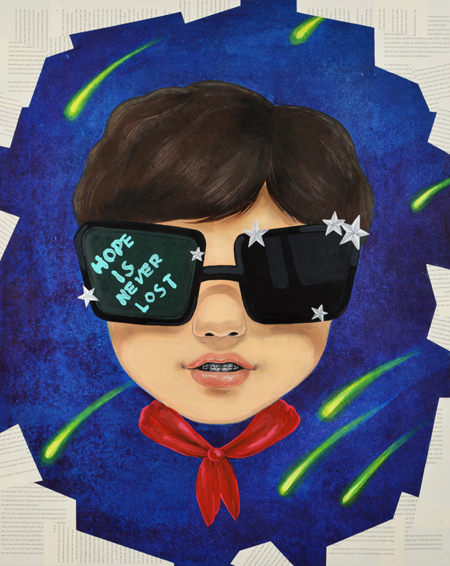 <Freedom is Not Free>는 욕망과 희망, 자유를 주제로 젊은 새터민들과 협업하여 진행한 프로젝트 작업 시리즈입니다.
1984년에 한국에서 태어나 자라난 작가에게 분단국이라는 정치적 이슈는 자연스러우면서도 떼어놓지 못하는 첨예한 지점에 있습니다. 분단 이후 태어난 많은 젊은 세대들에게 자유 민주주의는 익숙한 환경이지만, 반만년의 역사를 함께한 이북은 정치적으로 자유가 억압되고 폐쇄 된 공간입니다.
현재 자유를 찾아 남한에 자리 잡은 새터민들의 수는 3만을 넘었습니다. 목숨을 걸고 탈북을 시도한 이들에게 ‘남한’이라는 공간은 희망과 욕망, 판타지적 상상이 결합된 공간입니다. 이들이 목숨을 걸고 탈북을 하며 갖고 싶어 했던 가치는 어쩌면 우리에게는 익숙한 일상의 일부일도 모릅니다. 정치적인 자유가 억압된 곳에서 자유를 찾아 온 이들이 욕망했던 가치를 5가지 키워드로 바라보면서, 이 일상적이면서도 전부가 되는 가치를 통해 우리 곁에 공기처럼 존재하는 ‘자유’의 무게를 재고해보고자 합니다. 영국에서 출간한 자서전 <Every Falling star>와 <거리소년의 신발>의 저자 김성주 작가님과 협업한 작품 <Hope is never lost>입니다. 이성주님은 북한 꽃제비(노숙 거지) 출신으로 10대에 탈 북한 이후 명문대를 졸업하고 영국에서 석사를 마친 후 꾸준한 신념으로 꿈을 이루어 나가고 있습니다. 이성주님은 북한에서 별똥별을 보며 소원을 빌었던 순간처럼, 엄마와 친구들을 다시 보는 꿈을 그리고 있습니다.
이성주님의 욕망과 희망을 모티브로 한 작품에는 별똥별, 그리고 자서전이 오브제로 들어갔습니다. 성주님이 작품 안경에 자필로 쓴 문구는 ‘Hope is never lost’입니다.
ABOUT 이성주
어린 시절 부모에게 버림받았다는 사실은 트라우마로 자리 잡았다. 북한의 보통으로 살 수 있었지만 군인이셨던 아버지가 북한 체제에 대해 회의적인 말을 했다는 이유로 집안은 풍비박산이 났다. 북한에서는 사석에서라도 말을 할 자유가 없었다. 모두가 감시자였다.
외곽지역으로 추방되고, 살길을 마련해보고자 아버지와 엄마가 떠난 자리에서 나는 꽃제비가 되었다. 무리지어 소매치기를 하고 길에서 자고 음식을 구걸하며 역전과 강둑에서 잠을 청했다. 7명이었던 친구 무리 중 두 명이 죽었고, 직접 묻었다.
어느 날 브로커가 찾아와 아버지가 찾는다고, 남한으로 가자고 했다. 아버지에 대한 증오와 그리움이 얽혀 탈북을 결심하게 되었다. 강을 건너고 산을 넘어 도착한 남한에서 아버지 얼굴을 보는 순간 내 마음속에는 증오보다 그리움이 컸다는 것을 알았다. 춥고 굶주려 한 끼 밥을 위해 목숨을 걸고 살던 때에 하늘의 별을 보며 아버지 어머니를 떠올렸다. 별똥별에 소원을 빌면 이루어진다고 했다. 나의 가장 큰 소원은 부모님을 다시 만나는 것이었다.
처음 한국에서 펜을 사러 문구점을 들어갔던 날을 잊지 못한다. 북한에서는 펜이 한 종류 밖에 없었다. 수천자루의 펜 중에서 내가 선택한 펜을 살 수 있는 것, 그것은 ‘자유’였다.
그러나 한국에서의 몇 년은 꽃제비 시절보다 더 힘들었다. 북한 사람이라고 일자리를 얻기도 어려웠고, 정체성의 혼란이 왔다. 나는 온전하게 이곳에서 섞일 수 없는 이방인이었다. 사람은 밥으로만 살 수 없다는 것을 깨달았다.
10시간 이상 우직하게 공부하는 습관으로 명문대를 졸업하고, 영국에서 석사를 하고, 내 삶을 그린 책도 영문으로 출간하게 되었다.
Every falling star. 나는 별을 보고 기도했던 순간처럼 다시 희망을 그린다. 엄마와 친구들을 다시 보는 것. 북한에서는 꿈이 뭔지 몰랐지만, 이제는 꿈을 알고 있다. 그 꿈을 위해, 마음속 깊이 통일을 준비한다.
----------------------------------------------------------------------
<Freedom
is Not Free> is a series of project work in collaboration with young North
Korean defectors on the subject of desire, hope, and freedom.
The
political issue of a divided country is at a point where it is natural and cannot
be separated from the artist who was born in Korea in 1984 and raised in the
same country. For many young people born after the division, liberal democracy
might be a familiar environment, but the North, where we have shared a history
of more than half a century, is a space where political freedom is suppressed
and closed.
There are now more than 30 thousand North Korean
defectors who have found freedom in South Korea. For those who have tried to
escape with their lives at risk, ‘South Korea’ is a space that combines hope,
desire, and fantastical imagination. The value they wanted to attain even if it
meant risking their lives is just a part of our everyday lives. As I look at
the desired values of those who sought freedom from a place where political
freedom is suppressed in 5 kinds of keywords,I try to reconsider the weight
of ‘freedom’ that exists like air for us—ordinary but all-inclusive.
<Hope is never lost> is a work created in
collaboration with artist Kim Sung-ju, author of <Street Boy’s Shoes> and
<Every falling star>, an autobiography published in the UK. Lee Sung-ju
is a kotjebi (homeless beggar) from
North Korea and he escaped North Korea when he was a teenager. After escaping,
he graduated from a prestigious university and finished his master’s degree in
England, achieving his dreams with steadfast faith. Lee Sung-ju dreams to see
his mother and friends once again, just like the moment wherein he wished upon
a falling star in North Korea.
This work contains the motif of Lee Sung-ju’s
desires and hopes, with a falling star and autobiography as the objet. What
Sung-ju wrote in the work’s glasses is ‘Hope is never lost’ in his own
handwriting.
ABOUT Lee Sung-ju
The fact that I was abandoned by my parents in my
childhood became a trauma for me. Our family was able to live normally but it
soon scattered into pieces when my father, who was a soldier, said something
skeptical about the North Korean regime. In North Korea, there is no freedom to
speak even during unofficial occasions. Everyone is a watchdog.
We were banned to the outskirts of the country.
My mother and father left to make a living, and from there I became a kotjebi. I pickpocketed with others,
slept on the streets, begged for food, and slept in stations and river banks.
Among the 7 friends I had, 2 of them died, and we had to bury them.
One day, a broker came and told me my father was
looking for me, and that we should go to South Korea. My entangled feelings of
hatred and longing towards my father made me decide to escape. When I saw the
face of my father in South Korea after crossing the rivers and mountains, I
realized that my longing towards him was greater than hatred. When I was
risking my life to eat just one meal a day, I would look at the stars in the
sky and think about my mother and father. They say if you wish upon a falling
star, your wish will come true. My biggest wish was to meet my parents again.
I cannot forget the day I went to a stationery
shop in Korea to buy a pen. In North Korea, there is only one type of pen. Buying
the pen I chose among thousands of pens - this is ‘freedom.’
However, the few years in Korea were more
difficult than when I was a kotjebi. It
was difficult to get a job as a North Korean, and I was confused with my
identity. I was a stranger who could not perfectly blend here. I realized that
people cannot live solely on food.
With my habit of studying for more than 10
hours, I graduated from a prestigious university, took my master’s in the UK,
and published a book in English about my life.
Every falling star. I am drawing hope again,
just like the moment when I saw the stars and prayed - to meet my mother and
friends again. I did not know what a dream was in North Korea, but now I know.
For that dream, I prepare the unification deep inside my heart.
   |


 |